

What does the Instagram Performance Summary in Dashboard refer to?
If you're wondering what the Insights in the Instagram Performance Summary on the Dashboard actually represent, you're not alone. Since these figures are shown as percentage changes rather than raw numbers, it can sometimes be unclear how they are calculated.
In simple terms, the platform compares your Instagram performance from the currently selected date range with the immediately preceding period of the same length. It then calculates the percentage increase or decrease between the two periods to show performance trends clearly.
We gather all posts from the selected time period (for example, the last 6 months: 1 July 2025 – 31 December 2025) and calculate their total engagement and impressions.
We then gather all posts from the previous equivalent period (for example, 1 January 2025 – 30 June 2025) and calculate their total engagement and impressions.
Finally, we calculate the percentage change between both periods to determine whether your performance increased or decreased.
Let's look at an example.
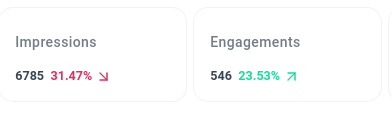
Example:
Your impressions in the current 6-month period are 18% lower than the previous period.
Your engagement in the current 6-month period is 27% higher than the previous period.
This means that while fewer people may have seen your content overall, a higher percentage of your audience interacted with it.
FAQs
1. What does the percentage change represent?
It represents the increase or decrease in performance compared to the previous equivalent time period.
2. Why is the previous period always the same length?
To ensure a fair comparison, the system compares two time periods of equal duration.
3. Does this calculation include all Instagram posts?
Yes, all posts published within the selected time range are included in the calculation.
4. Can I change the comparison period?
You cannot manually select the previous comparison period. It is automatically set to match the length of your selected date range.
Was this article helpful?